

At the beginning of 2020, Dignitas was considered a savvy team in the LCS transfer market when they successfully retained Huni, the team’s star player, with a contract worth over $2.3 million. However, when it came to actual gameplay, Huni did not prove himself to be a big star; he still required resources and support, but when the team needed him, he failed to deliver.

As a result, Dignitas had a terrible spring season, finishing in 7th-8th place, tied with Immortals and only above the sinking ship Liquid and the “point farm” named CLG. The painful irony is that the two players discarded by the organization, Codysun and Vulcan, secured playoff spots with 100 Thieves and Cloud 9.

This is clearly very disappointing, and the organization has taken initial steps towards changing personnel. Just a few hours ago, the official Twitter account of this team announced that Huni is free to seek new opportunities ahead of the upcoming summer split, which means that the former SKT T1 star’s stay at Dignitas is nearly impossible.
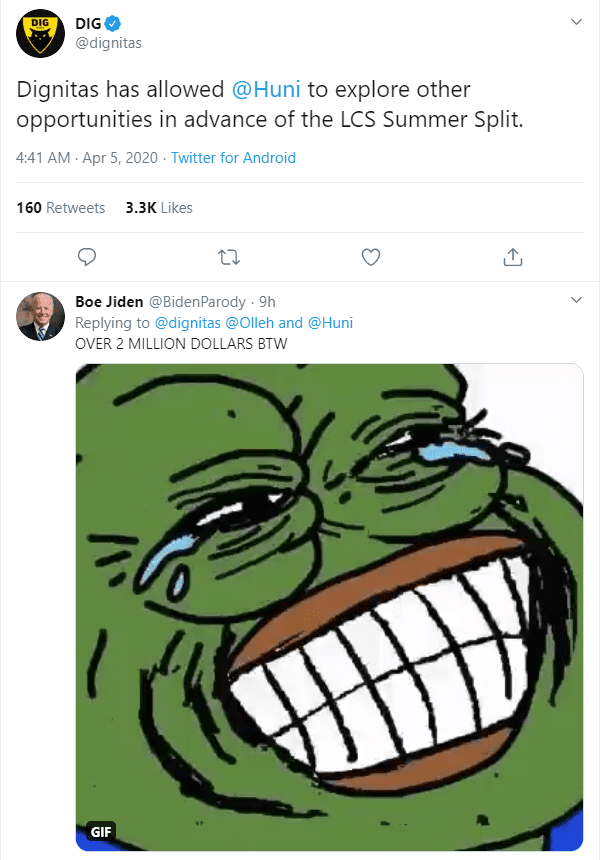
Dignitas: “The Dignitas organization has allowed Huni to seek new opportunities before the upcoming summer LCS tournament.”
A comment below: That contract worth over $2 million.
With these seemingly tough moves from Dignitas, Huni’s departure is just a matter of time. He must find a new landing spot before competing in the summer LCS, but looking across North America right now, it’s quite difficult to find a team willing to take him on. The biggest issue for him is that his motivation to compete has dropped significantly, and he’s just playing to finish, so which team would dare to pick up a “burden” like that?

Moreover, teams in the LCS such as Cloud 9, Evil Geniuses, or Fly Quest have already found their stable rhythm, and bringing Huni in would only be detrimental. Remember that only the aforementioned teams can afford the exorbitant salary that Dignitas signed with Huni at the beginning of this year.

It’s sad for a talented player like Huni to find himself in a situation where he is becoming a “burden,” with no one wanting to buy and the organization wanting to sell.