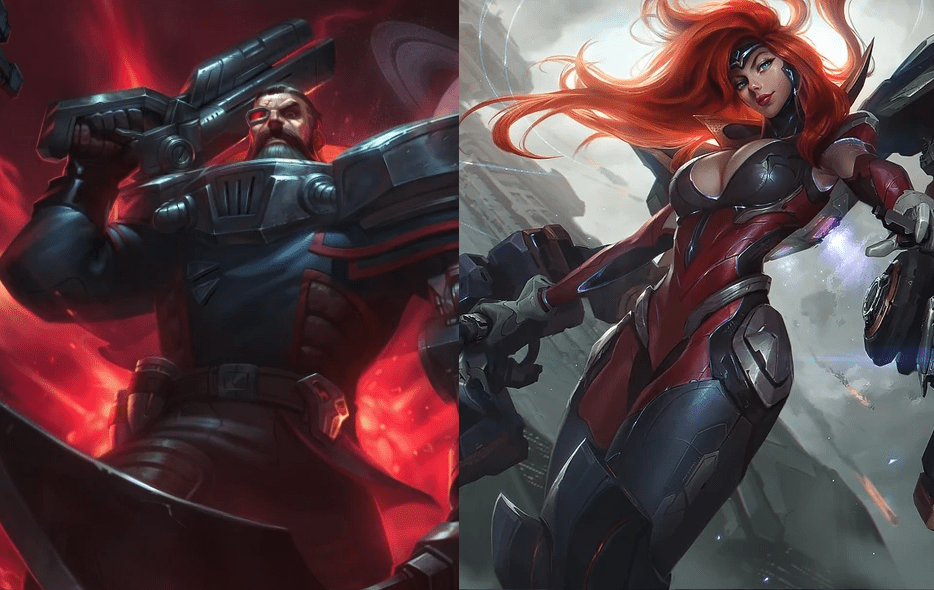
Hyper-roll
First appearing in Season 1 of Teamfight Tactics, Hyper-roll has a basic playstyle that involves rolling a lot to get 1-cost units to 3 stars, thereby snowballing the game with a win streak. The principle of this playstyle is that you will not level up or roll champions before round 3-1 and keep yourself at level 4, represented by Xayah Hyper-roll and most recently 3-star Ziggs. Of course, you still need to buy the necessary champions but should not roll too early.

By the time you reach round 3-1, when you have 8/10 experience to level up to 5, you roll all your money to upgrade as many 1-cost core units to 3 stars as possible. The strength of this playstyle is that it gives you a strong midgame with cash in hand and full health because it is difficult for any team at levels 6-7 to beat your 2-3 3-star units. However, the weakness is that when opponents reach level 8 with a full team, it will be very hard to win decisively.

There are 2 signs for you to choose a hyper-roll composition: one is having early 2-star core units like Ziggs, Xayah, and other opponents do not have many units you intend to “gold-fingered”. The second sign is if the game gives you the necessary items for your core units (Spear of Shojin, Infinity Edge for Xayah or Ziggs with 4 Tears of the Goddess). If not, you should abandon hyper-roll and switch to another composition.
Slow-roll
Many players will confuse the slow-roll playstyle with hyper-roll due to their similarities, but in essence, they are quite different. The slow-roll composition does not necessarily require all-in on money at a specific round to get 3 stars; instead, you can be assured that at the 2-star threshold, your 2-3 cost units are completely strong and playable.

The main playstyle of this approach is not to roll at all before the Stone Golem round, still level up normally, and accumulate 50 gold as quickly as possible. After you reach a solid level, you will roll down to the 50 gold threshold in every round to find the necessary units and upgrade them to 3 stars. If you need a 3-cost unit, stop at level 7; if you need a 2-cost unit, roll at level 6.
The compositions that apply this style are “Bounty Hunter” Darius (or Pirates – Universe) and Pilot – Spy. These are compositions that rely heavily on items and should only be played if you have important items like Giant Slayer when playing Darius or defensive items when playing Pilot – Spy. Another issue is that the 2-3 cost units only support 1 player to reach 3 stars; if you see several other players playing the same strategy as you or have many units you need, abandoning is the best choice.
Power Level
This playstyle is only for compositions that are strong in the late game when you have a full team, necessary combos, and rely on expensive 4-5 cost champions. Not only champions, but leveling up will also give you an additional position on the board, and Power Level compositions take advantage of this best when each piece is important and activates a certain combo.

The most typical examples of this playstyle are the Rebel and Cybernetic compositions. Their strength depends on having strong 5-cost units (Aurelion Sol, Ekko) to deal damage or activate their traits. This means that most of the time you play a Power Level composition, leveling up is frequently happening instead of rolling to find champions for upgrades.

The mistake of most players when playing Power Level compositions is getting greedy and rolling for 3-star champions while neglecting their economy. Remember that the strength of this type of composition mainly relies on 5-cost champions; you need to have a strong enough economy in the late game to roll and upgrade them to 2 stars. You might get 1-2 3-star 1-cost champions through rolling, but if your Aurelion Sol, Gangplank, and Miss Fortune are still in “child form,” winning seems nearly impossible.