

Definition and Basic Concepts of League of Legends Tools
Since League of Legends became the “national game” in Vietnam, the local gaming community has become accustomed to the phenomenon of “living with tools.” In terms of media and community, this is considered a “plague” causing many headaches for both publishers and players.
In reality, the issue of using tools in League of Legends (LoL) is not limited to any specific server region; it has circulated almost worldwide. Not only Garena, but even Riot Games and Tencent Games (the partner operating LoL in China) have been “unable to handle” it.
So what are League of Legends tools? And how do they affect the ecosystem of one of the most famous esports titles in the world?
Originating in North America in 2014, League of Legends tools were released by Legendshap, a studio based in Germany. In 2015, this studio was sued and had to compensate Riot Games for distributing third-party software that affected the ecosystem of LoL. However, the “first shot” from Legendshap opened a wave of underground activity in the LoL community, where many players found ways to achieve victory without going through the challenging path of improving their skills.
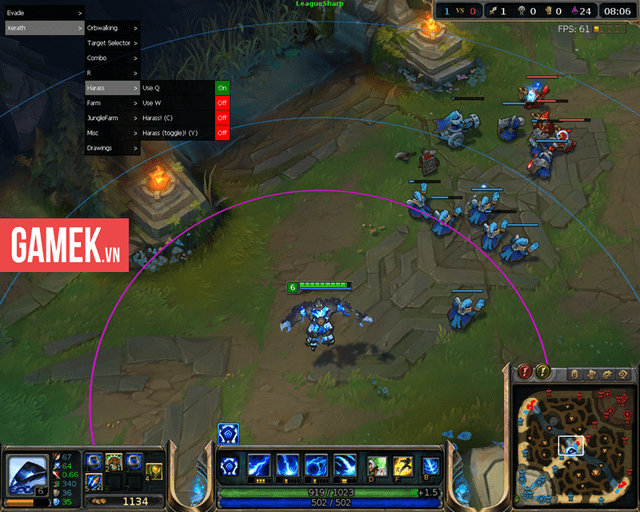
Specifically, a tool is a type of software designed based on auto-click algorithms. This is not considered a game hack—a different form of “cheating” based on cheats and bugs. In the initial versions, the tool only had features for statistical analysis, reading coordinates, and mouse capturing.
Over time, the tool has been upgraded to versions with unique functionalities, helping users become “gods”. To put it humorously, they gain the “Heavenly Eye” and “Three Steps Through the Sky,” allowing them to broaden map vision and read opponents’ movement and actions to dodge easily.
Why Are Tools So Popular?
Similar to game hacks, tools inherently have had a wide-ranging influence and reach in LoL since their inception. The reason is simple: using tools allows players to achieve victories more easily, making the experience feel more like “I’m gosu”.
Instead of spending time trying hard to improve their mindset and skills, players can simply spend a small amount of money to enjoy the feeling of dodging skills like Faker. Overall, the existence and development of tools until today are based on two fundamental strengths: effectiveness and affordability.
Riot Games clearly understands this, and the creators of LoL have dedicated a lot of effort to counteracting the abuse of tools in the game. But the issue is, there will never be a situation where game developers can completely eliminate tools or hacks from the game, as both hacks and tools are inherently produced from the very source codes of the game, and even when upgrading security systems, hacking and tool software will continue to “evolve” accordingly.
As mentioned, one of the reasons tools have become popular is that they help “elevate” players’ skills unconditionally. Current statistics show that, based on ranking tiers, only 10% of all LoL players reach the Platinum rank—a benchmark considered “above average” in this game, and only 1.8% achieve the Diamond rank, meaning they are skilled in both mindset and technique but have not reached high-level status.
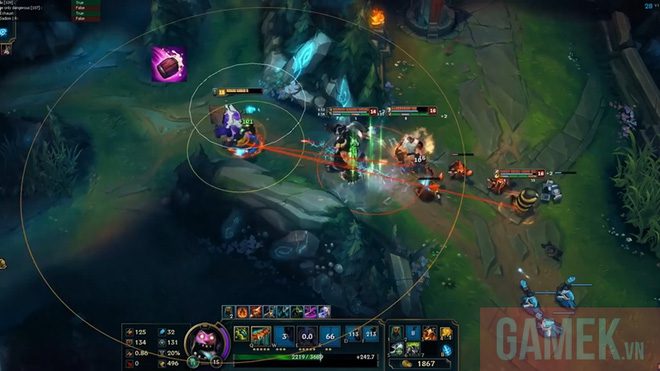
Gamers’ psychology when engaging with a game naturally drives them to assert themselves through victories and impressive statistics, with the clearest evidence being through their rank. If a player does not fall within the 10% that achieves the Platinum rank, it means they are merely at an average level in the game. To improve this, they only have one option if they want to follow the “correct path”: to enhance their skills and gaming knowledge.
However, this is not an issue that can be solved simply by being “diligent to make up for intelligence”; in reality, LoL is a game that requires many factors related to reflexes, perception, and flexible thinking. It possesses a massive data set and requires agile gameplay control. All of these factors somewhat require a bit of “innate talent,” and even when players focus on trying hard, it’s hard to know how much is enough, because “you progress but others don’t just sit still!”
And thus, tools become a lifesaver for players who want to rank up but whose skill level does not allow it, or simply for a bit of “virtual living,” wanting to show off their prowess or post some highlights…
Speaking of the popularity of LoL tools, simply typing this keyword into Google can yield tens of thousands of search results in 0.5 seconds, most of which will lead viewers to addresses buying and selling various tools.
According to some “insiders,” the prices of LoL tool software are quite varied, with the cheapest being 1,000 VND per hour of use, up to “higher-end” types costing 70,000 VND for 24 hours of use.
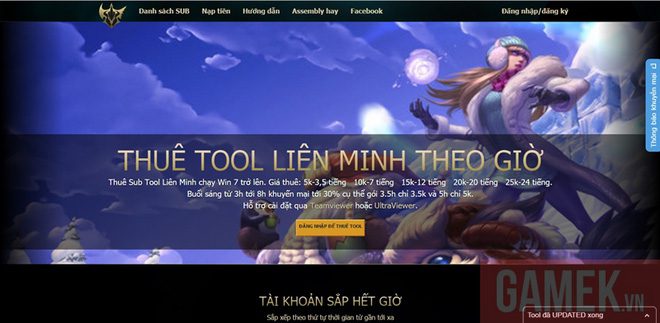
This classification is based on the criteria of the software’s safety; the higher the price, the more difficult it is for Riot Games’ anti-third-party software tools to detect it, meaning the safety level for users will be better.
However, no tool distributor dares to guarantee their customers absolute safety even when using the most VIP tool packages, as one way or another, Riot Games still has the ability to conduct sweeps and ban accounts using tools.
So the question arises: why do so many gamers continue to use tools despite facing certain “punishments”? This can only be examined from two perspectives: psychology and habit.
Once again, we must refer back to the earlier discussion: What will you do if you want to win but… can’t? One is to try hard, the other is to use tools as a technical aid. According to the experiences of those who have used tools, using this software helps them increase their “virtual level” by at least 2 rank tiers; if their actual skill level is Gold I, then with the tool, they will play like a Diamond player, with super dodging abilities and reflexes that are… suspiciously quick.
The rapid advancement of skill level without any effort can easily lead to a sense of… addiction. Once addicted, people will disregard many things. Even if Riot Games or Garena provides a list of tens of thousands of players banned every day, many gamers still murmur: “They must be leaving me out.”
Furthermore, once they start using tools, it will be very difficult for players to break free. Because relying too much on support tools will lead to their own skills gradually diminishing. It’s similar to what happens in the animated film Wall-E, where humans even lose their ability to walk on their own when they become overly dependent on personal moving machines.
A player accustomed to tools, when they don’t have this support tool, will easily realize that they have lost themselves, playing worse than their actual previous skill level. A feeling of “being trapped” when playing with their true abilities will only make them more dependent on tools.
Tools – An Inevitable Part of the Online Gaming Ecosystem and the Conflict of Interest Between Individuals and the Community
In the previous article, we explored the basic concepts of League of Legends tools and how they have become popular in the community. Today, let’s continue to delve deeper into this issue. Do tool users have their own reasoning, and does the community have grounds to accept those reasons?
The reality is that if we classify tools as a form of third-party software interfering with the normal game mechanics, then surely most of us have “used tools” before. But here, tools refer to MMORPG games—online role-playing games.
For example, you’ve surely heard the stories of “downloading auto Võ Lâm Truyền Kỳ” or “auto Phong Thần”, right? These are also forms of tools based on auto-click, which are extremely effective in assisting players during their grind, such as automatic pathfinding, auto farming monsters, etc. These software applications, although developed by third parties, are rarely addressed by publishers, as in terms of functionality, they only bring positive effects to players.
Moreover, if we look at the history of MMO games, we can easily see that many modern games released after 2010 even integrated these features into the game, creating an era of “auto-playing games.”
Many players of MOBA and ARTS games later on are often long-time gamers from the MMO genre, so the habit of using tools quietly seeped into the LoL community. For players who distinctly differentiate between skill levels, they will oppose the use of tools to interfere with a skill-based game that has no grinding elements. Because relying on third-party software to “cheat” skill levels is unfair to gamers who have risen through their own abilities.
However, from the perspective of tool users, they simply view this as a hobby or personal enjoyment. Where there is supply, there is demand, and vice versa. The fact is that currently, no country has applied specific legal measures to address the use of cheating software. Typically, governments target the producers and distributors of tools because the conflict of interest with game publishers is sufficient to constitute a legal violation, but rarely penalize the users themselves.
For most of the group of players using tools, they accept spending money to buy them, acknowledging that their accounts may be banned at any time. Then, with just about 50,000 – 100,000 VND for a new “clean” account, they will repeat that action. From the perspective of many tool users, they spend money to enjoy the feeling of victory—a very common mentality in the MMO gaming culture that has lasted for nearly two decades.
But the problem lies here: their personal joy directly conflicts with the interests of the community, as mentioned earlier. The publishers’ denunciation of the tool and hack issue, in legal terms, is often regarded as a distinct rule of each community rather than a violation of the law. In some countries, the use of third-party software can also be penalized but usually only results in administrative fines.
In recent years, regions like China, Taiwan, and Southeast Asia have become “red zones” where third-party software has become widespread and influential across all popular games, not just LoL. One of the reasons why Riot Games, Garena, and even Tencent have become powerless in controlling tools is due to the sheer number of software distribution points that emerge daily, turning it into a “cross-border” business activity.
Tools produced in China, Turkey, or Europe are often not distributed domestically due to the ease of legal enforcement. Instead, they are usually circulated abroad, sold to users in neighboring countries, or regions where the management of game publishers is not strict enough.
A “shop” distributing tools can have anywhere from dozens to hundreds of orders each day, and this business will not encounter too many obstacles because when game publishers upgrade their anti-third-party software tools, the tool producers immediately release corresponding “updates”. And importantly, as long as the demand from players for using tools remains high, the tool trade will continue smoothly.
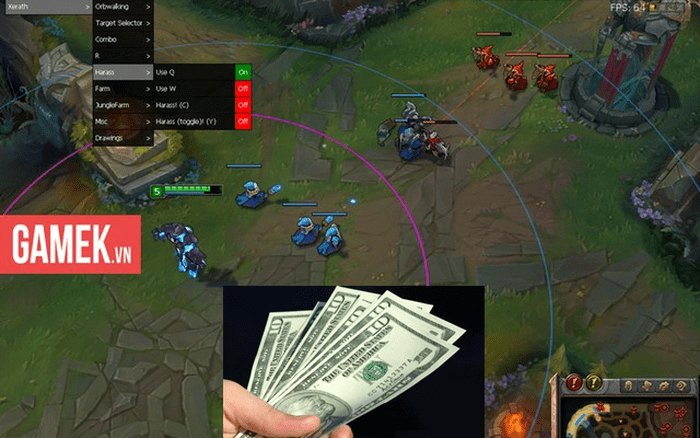
With that said, we must return to the issue of perspective and thought. The story of coexisting with tools can be summed up as a conflict between personal preference and community interest. The reality is that not every gamer spends significant time contemplating larger issues beyond just enjoying the game, and discussions about awareness will likely remain at meaningless criticisms, as the ideologies between the “tool” and “skill” factions are inherently too different.
The tool and hack problem will never be resolved completely, as aside from the technical aspects, directing millions of players towards a unified thought process and mindset is truly a fanciful dream.