

In recent years, a plethora of mobile MOBA games have emerged, creating a real sensation in the gaming community. This is a fertile ground with enormous potential for exploitation, prompting many publishers to vie for dominance. This is why Riot Games, after more than 10 years focusing solely on League of Legends on PC, announced and entered the testing phase for League of Legends: Wild Rift, promising a release in the near future.

Interestingly, the Philippines, known for DOTA2 being the “national game,” is one of the places selected to test League of Legends: Wild Rift. It’s no surprise that DOTA2 players harbor disdain for League of Legends, so the appearance of League of Legends: Wild Rift in this country is bound to irritate the “elite” community here, prompting their own reactions.

Notably, the commentator KuyaNic, a significant figure in the DOTA2 community in the Philippines, went live with the title “Dota 2 Mobile Alma Test!” which took many by surprise. The most remarkable aspect is that he streamed gameplay of DOTA2 Mobile as if it were real, even using Invoker, a hero with an incredibly complex skill set. This so-called “mobile” version even featured all the functionalities of the Battle Pass for TI10.
The game ran so smoothly that it was hard to believe it was real. Although it “looked real,” KuyaNic’s video did not escape the attention of sharp-eyed players. Numerous pieces of evidence suggest that this was actually just a normal DOTA2 game, with him merely overlaying a mobile interface onto it.
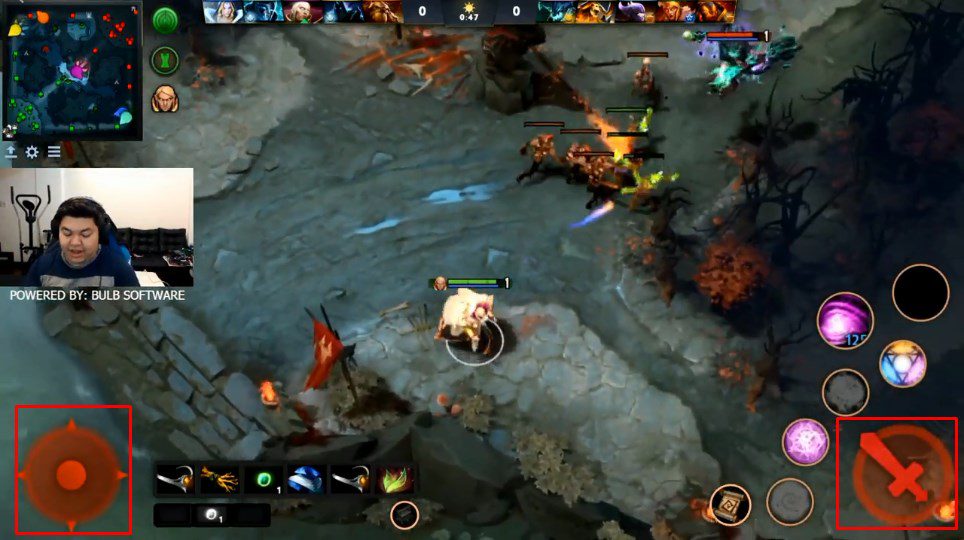
Firstly, we can clearly see that in the video above, there are no signs of KuyaNic tapping on a phone screen to control the hero. In contrast, in other mobile games when live streaming, actions like moving the hero or basic attacks are displayed on the screen.
Furthermore, in games like Arena of Valor, players cannot perform skill cancel animations, meaning canceling the animation of using skills or basic attacks. However, in the aforementioned video, we see Invoker performing this skill continuously, very similar to pressing the S key on a regular keyboard, making it hard to believe this is a mobile game.
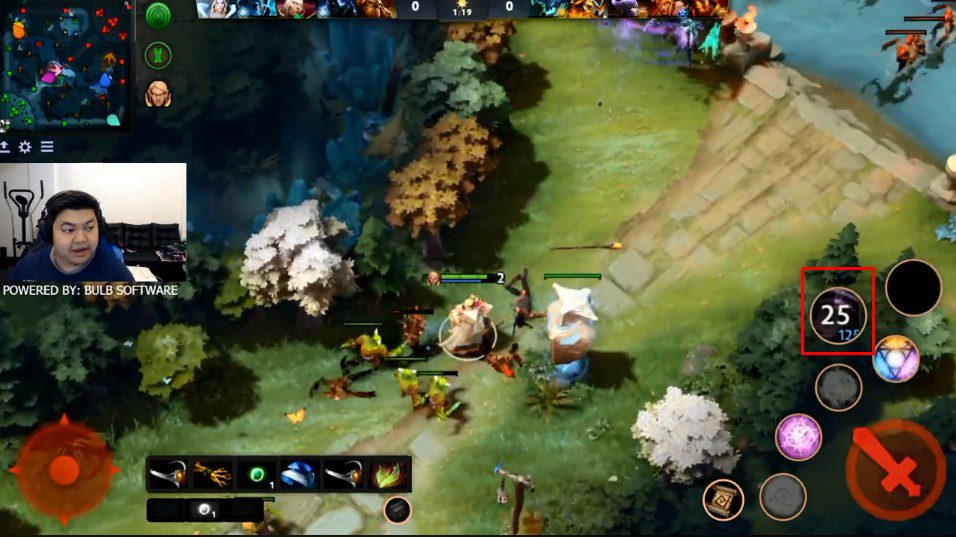
The second point that makes people believe this is a “scam” by the Filipino streamer is the design flaw in the interface. We can see that in the skill box in the video, there is a small line below to show the energy cost. However, due to the mobile interface’s skill box being circular instead of square like in DOTA2, it obscures most of the number 5 in the 125 energy cost.
Remember that Valve is a very meticulous game developer; if they were to create a real DOTA2 Mobile, there would be no silly errors like this. This indicates that this is merely a fan-made product by a player.
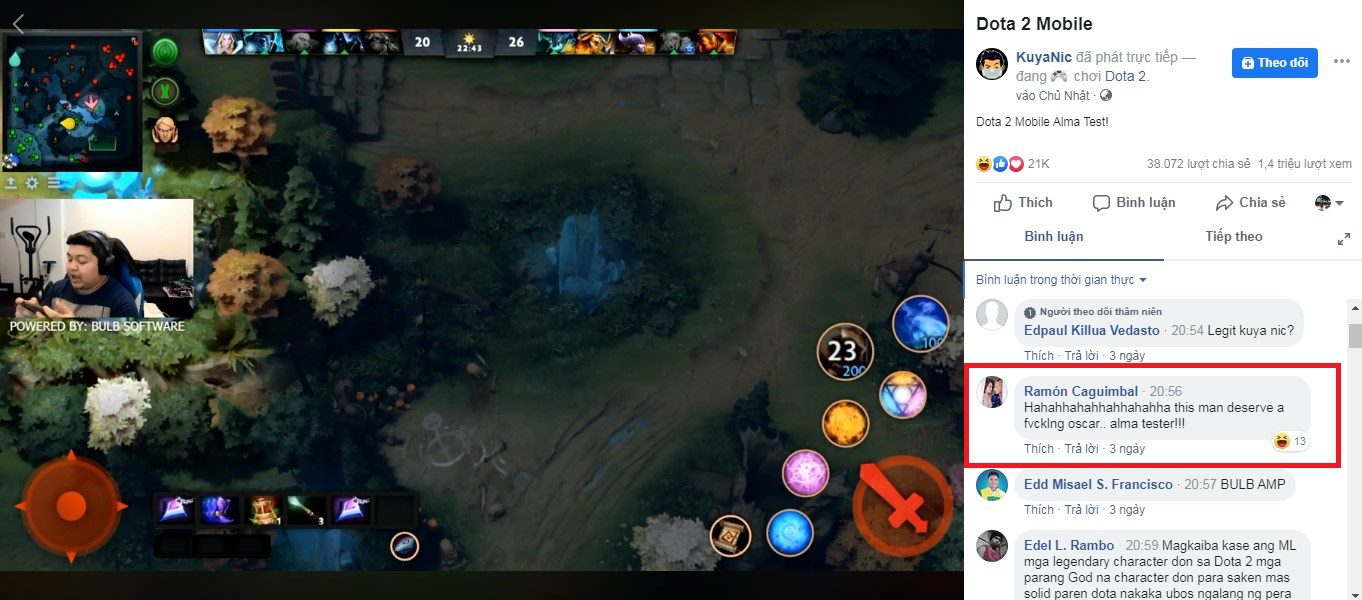
KuyaNic’s live stream was conducted three days ago, just a few days after League of Legends: Wild Rift officially tested in the Philippines. This can be seen as a statement from the DOTA2 community in the Philippines that if they wanted, they could have their own mobile MOBA game without needing to run to League of Legends: Wild Rift.

However, the reality is that the prospect of DOTA2 Mobile appearing is very slim; this game has too many complex mechanisms, and matches take place over a relatively long period. Meanwhile, mobile game criteria emphasize simplicity, ease of understanding, and quick play. Furthermore, Valve does not have a strong presence in the mobile sector, making it very difficult for them to create a mobile game.
Perhaps KuyaNic’s video is merely a “fan-made” product or serves some form of “diss,” as the idea of bringing DOTA2 to mobile is nearly impossible.