

Most of T1’s Revenue Actually Comes from Their Fans
As widely known, investing in Esports today is almost certain to incur losses. There are many reasons, and depending on the region and team, these losses may vary in scale. However, if you were to name a team that still turns a profit from Esports investment, most in the community would think of T1, with their highest revenue stream undoubtedly coming from League of Legends.

According to recent Korean media reports, T1’s 2025 revenue reached 90.5 billion KRW (approximately 1.6 trillion VND), ranking around fourth among all sports clubs in South Korea. In this report, ticket sales were not a major source of income; instead, T1’s primary revenue came from goods sales (jerseys, player- and team-related gifts, etc.).
Furthermore, statistics shared on FmKorea indicate that T1’s player jersey sales last year rivaled those of the KIA Tigers, one of the most historically significant and popular baseball teams in Korea. In South Korea, baseball is among the most beloved sports, arguably even more popular than soccer.
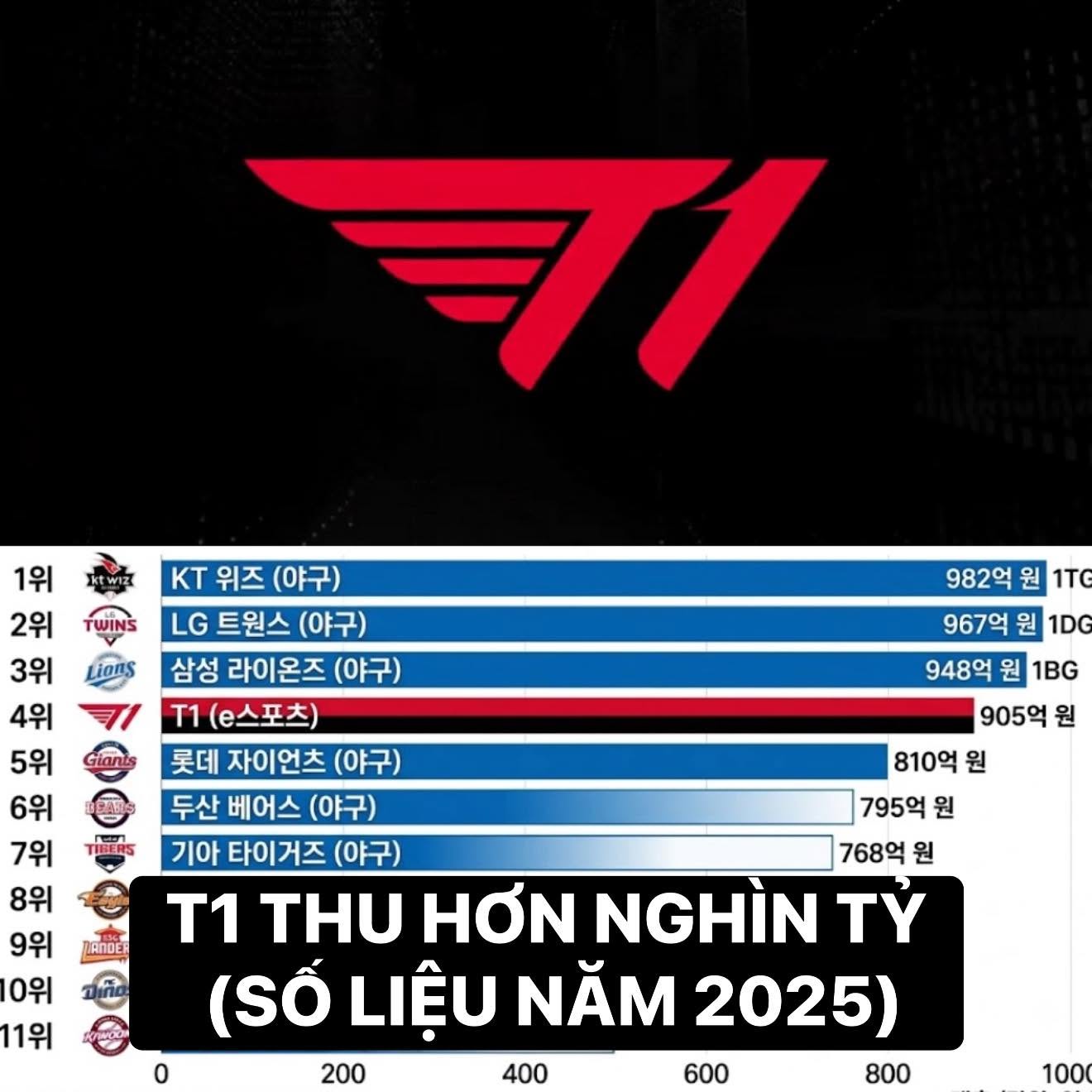
Naturally, such high merchandise revenue is undoubtedly thanks to T1’s fans. Moreover, it goes without saying that the large and particularly generous fangirl community accounts for the majority of player merchandise sales.
– Looking at the numbers, the power of the fans cannot be underestimated
– Yet last year, many criticized claims that T1 lives off its fanbase
– Truly, T1’s fans, especially the fangirls, are a formidable financial force

But T1’s Model Is Difficult for Other Teams to Replicate
In reality, achieving what T1 has requires many factors, most importantly Faker and the team’s achievements. At T1, other players like Zues and Gumayusi have also risen to visual prominence following Faker. But from the very first factor—Faker—no other team likely can match.